
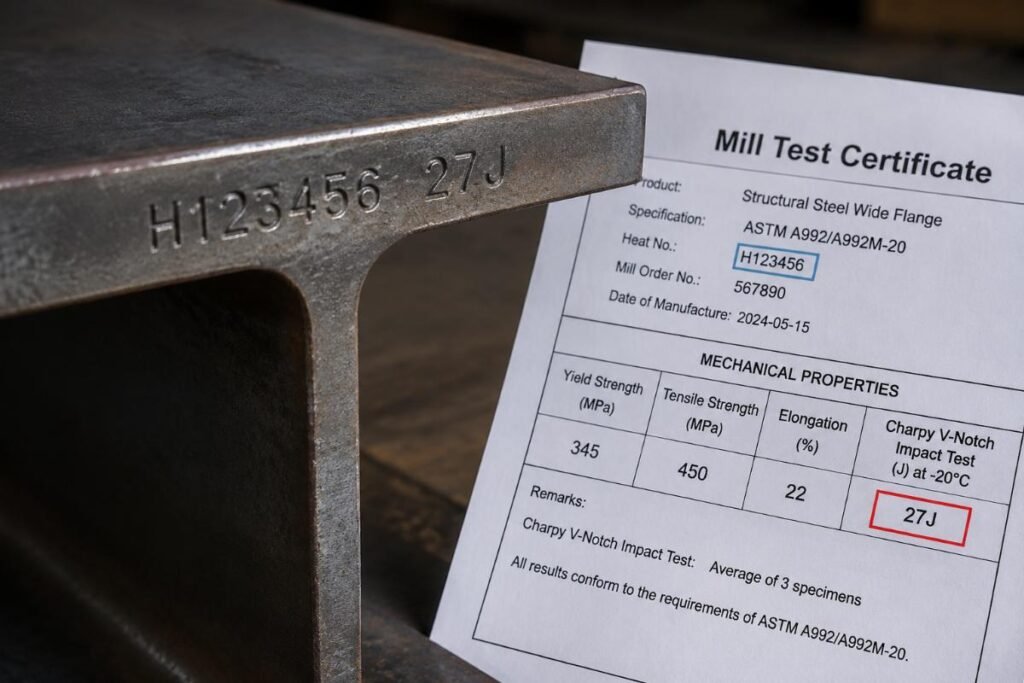
S355JR Structural Steel Beam EN Certified Manufacturer for EU
A certificate that simply states “S355JR” is often worthless at the customs gate.
For buyers in the EU and Middle East, a valid S355JR certification requires explicit impact energy values of 27J at 20°C and traceable heat numbers per EN10219 or EN10025-2 standards. Without these specific data points, even high-quality steel will be rejected during site inspection or held at port due to non-compliance with structural safety codes.
I still remember the humidity of the Jebel Ali port office, staring at a stack of paperwork that had just cost my client weeks of demurrage charges. The steel itself was perfect—straight, clean, and strong. But the Mill Test Certificate (MTC) listed the impact test result merely as “ambient temperature.” The site engineer, a meticulous professional from a major European EPC firm, refused to accept it. He didn’t care that the steel passed; he cared that the document did not prove it passed under the specific conditions required by the project’s technical specifications. That incident shifted my entire approach to documentation. I learned that in international structural steel trade, the paper is as critical as the metal. [NEED_CITE: importance of MTC specificity in construction compliance]
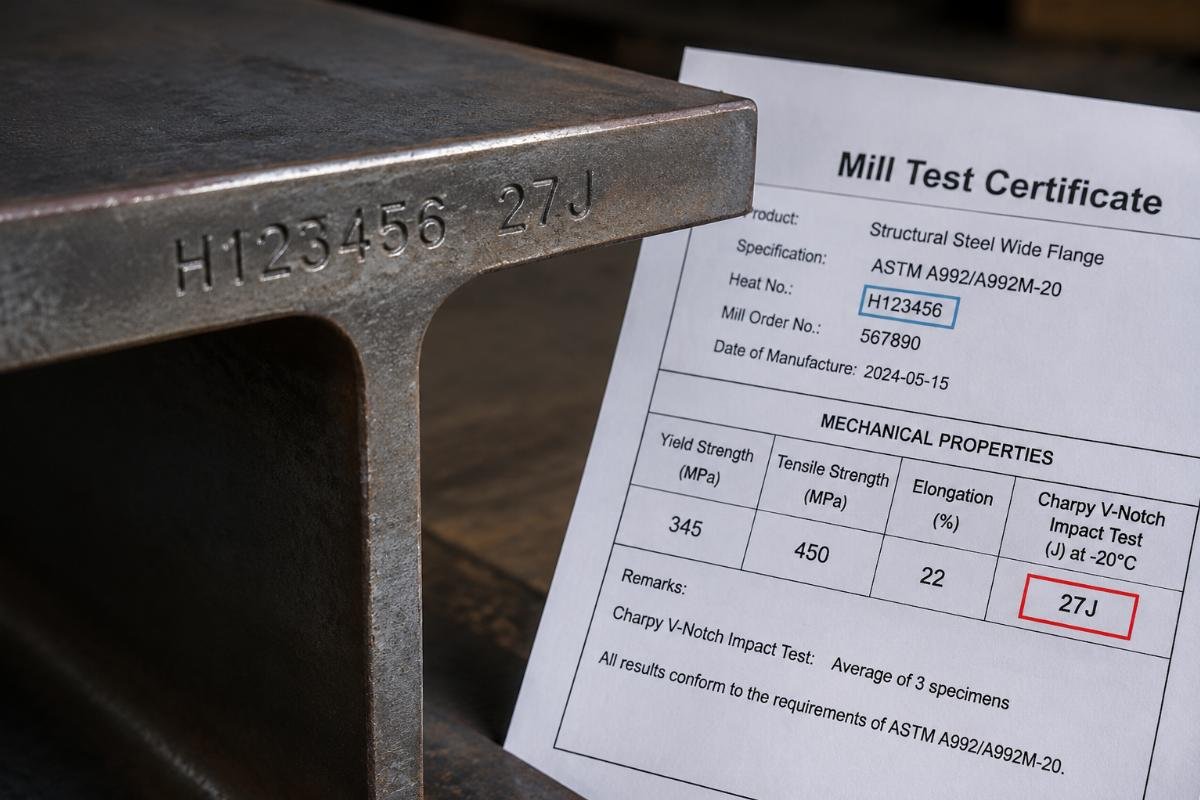
This guide breaks down exactly what makes a S355JR Structural Steel Beam Certification valid, how to verify it before shipment, and why generic descriptions fail in rigorous markets.
Why Do S355JR Certificates Get Rejected at EU/Middle East Sites?
Vague impact test data is the primary cause of rejection, not the steel quality itself.
Many suppliers assume that labeling a beam as S355JR is sufficient because the grade implies certain properties. However, structural engineers and procurement officers in regions like the Gulf Cooperation Council (GCC) countries and the European Union require proof, not implication. The “JR” in S355JR stands for specific impact resistance requirements at room temperature (20°C). If the certificate does not explicitly state the test temperature and the resulting energy value in Joules, it is technically incomplete for structural applications governed by Eurocodes or equivalent local standards. [NEED_CITE: EN10025-2 impact testing requirements for JR subgrade]
Consider a recent case involving a distributor consolidating mixed containers for a project in Riyadh. The supplier provided certificates that grouped multiple heats into a single average value. While this might pass for non-critical fencing, it is unacceptable for load-bearing columns. The site inspector requested individual heat analysis for each bundle. Because the documents lacked this granularity, the entire container was quarantined for third-party verification. The cost of re-testing and storage far exceeded the price difference of sourcing from a manufacturer who provides detailed, heat-specific documentation from the start.
The root issue is often a mismatch between commercial trading habits and engineering rigor. Traders may view certificates as administrative formalities, but engineers view them as legal liabilities. A S355JR Structural Steel Beam Certification must serve as a legal guarantee that the material meets the mechanical properties claimed. When the data is ambiguous, the default assumption in high-liability projects is rejection. [NEED_CITE: risk management in structural steel procurement]
What Must a Valid S355JR Mill Test Certificate Include?
Mandatory fields include heat number, chemical composition, yield strength, and specific 20°C impact values.
A compliant MTC is not just a summary; it is a detailed record of the production batch. To avoid delays, buyers must ensure their S355JR Structural Steel Beam Certification contains the following verifiable elements. Missing any of these can trigger a request for additional testing or outright refusal of goods.
| Parameter | Required Detail | Common Error |
|---|---|---|
| Standard Reference | EN10025-2 or EN10219 | Listing only ASTM or generic “International Standard” |
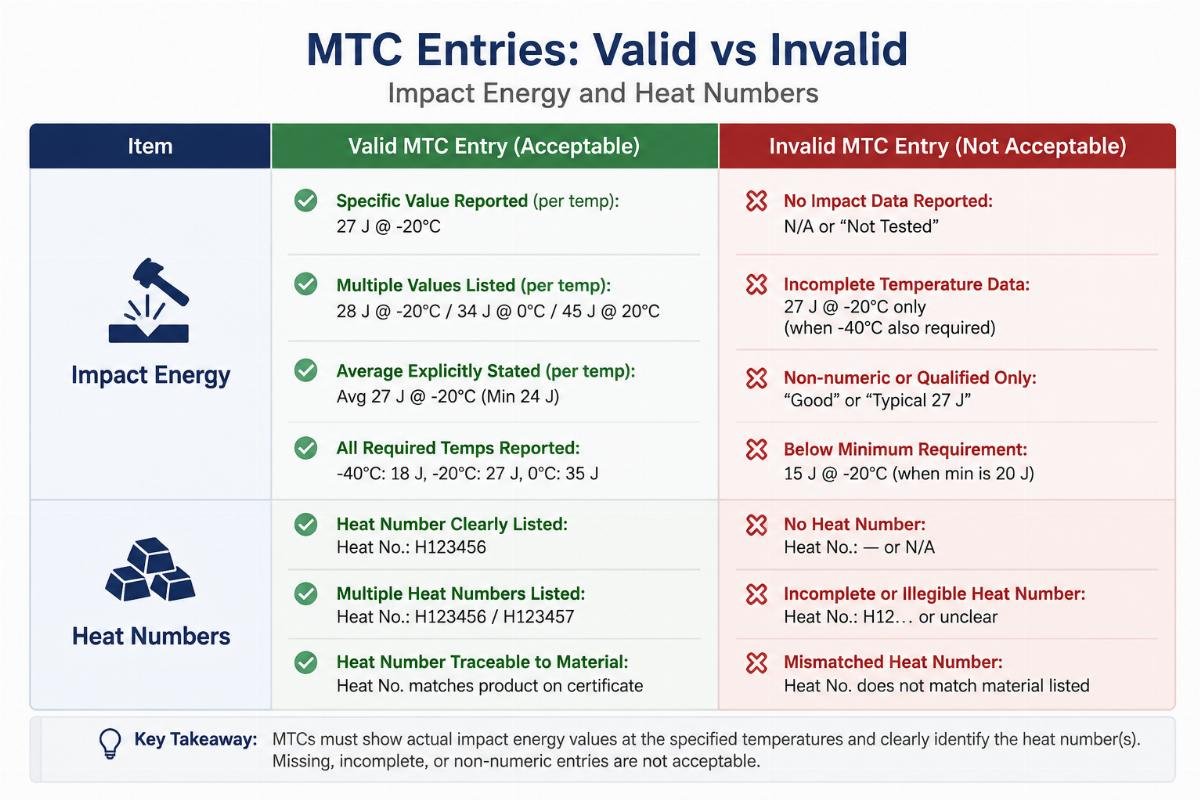
| Heat Number | Unique identifier per batch | Grouping multiple heats without individual breakdown |
| Chemical Composition | % of C, Mn, Si, P, S | Omitting trace elements required for weldability |
| Yield Strength | Minimum 355 MPa | Reporting only tensile strength |
| Impact Energy | Value in Joules at 20°C | Stating “Passed” or “Ambient Temp” without numeric value |
| Traceability | Link to original mill slab | No reference to primary producer |
The impact energy value is the most frequent point of failure. For S355JR, the standard requires a minimum average impact energy of 27 Joules at 20°C. A certificate that reads “Impact Test: OK” is insufficient. It must read “Impact Energy: 45J @ 20°C” or similar specific data. This specificity allows engineers to verify that the steel maintains toughness in the expected service environment. [NEED_CITE: mechanical property thresholds for S355JR]
Furthermore, the chemical composition must align with the grade. High carbon content, for instance, can improve strength but reduce weldability, which is critical for structural beams. A robust S355JR Structural Steel Beam Certification will list the actual ladle analysis results, not just the permissible limits. This transparency builds trust and facilitates faster approval from quality control teams on site.
How to Verify Traceability from Beam to Certificate?
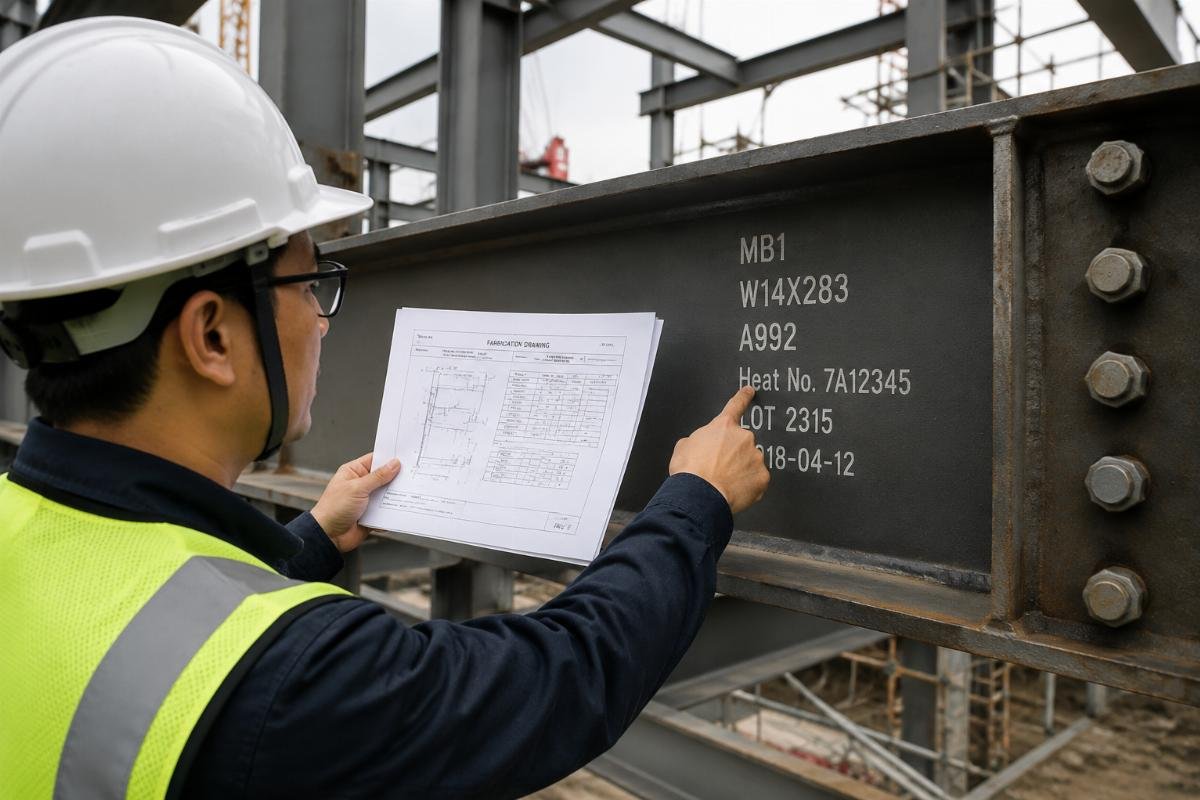
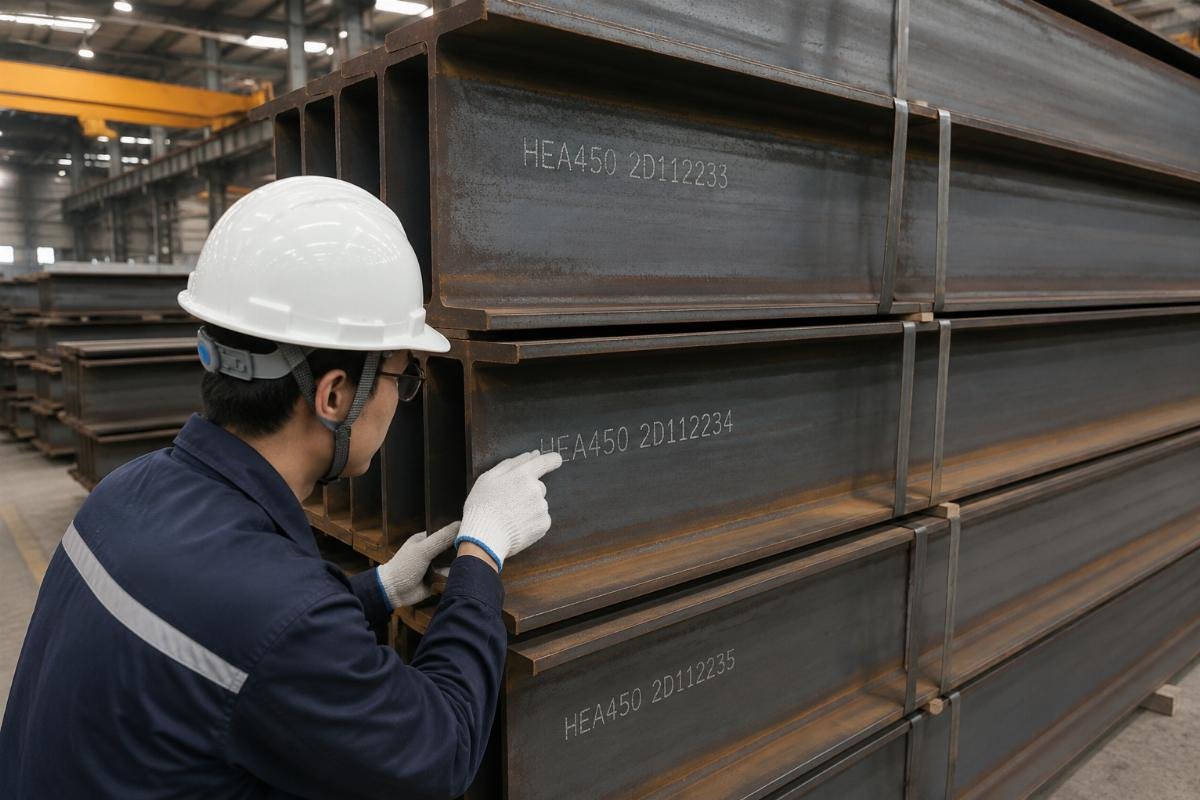
Physical heat number stamping must match the MTC exactly.
Documentation is useless if it cannot be linked to the physical product. Traceability is the bridge between the paper certificate and the steel beam sitting in the yard. Every beam produced under EN standards must carry a visible stamp or tag indicating its heat number. This number must correspond precisely to the heat number listed on the S355JR Structural Steel Beam Certification.
In my experience, discrepancies often arise during transshipment or when distributors repackage goods. A beam might be stripped of its original tags, or a new tag might be applied incorrectly. To prevent this, buyers should implement a pre-shipment inspection protocol that includes random sampling of heat numbers. Select a few beams from different bundles, record their stamped numbers, and cross-reference them with the provided MTCs. If the numbers do not match, the entire batch’s integrity is questionable.
Another common issue is the legibility of stamps. Hot-rolled beams can have faint markings due to surface oxidation or rolling processes. Ensuring that the manufacturer uses durable marking methods, such as deep stamping or weather-resistant tags, is crucial. If the stamp is unreadable upon arrival, the buyer faces the same dilemma as having no certificate at all: they must either accept the risk or pay for expensive non-destructive testing to verify the grade. [NEED_CITE: traceability requirements in EN10204]
Visual inspection goes beyond just the number. Check for consistency in the font and placement of the stamp across the batch. Inconsistent marking can indicate that beams from different origins have been mixed. A reliable manufacturer ensures that every piece of steel leaving their facility is clearly identified, making the verification process straightforward for the receiver. This attention to detail is a hallmark of a professional S355JR Structural Steel Beam Certification provider.
EN10219 vs. EN10025: Which Certification Does Your Project Need?
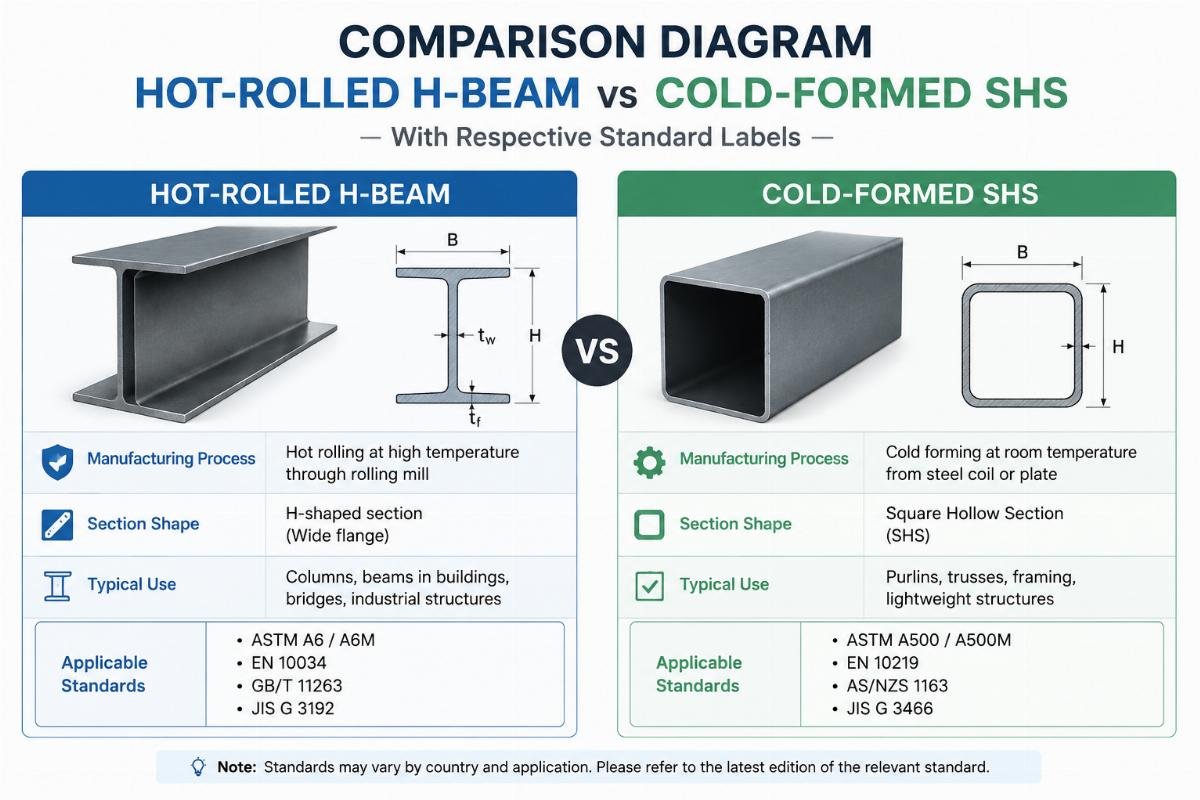
Distinction based on manufacturing process and structural application determines the correct standard.
Confusion between EN10025-2 and EN10219 is common among buyers who are not deeply familiar with European steel standards. Both standards cover S355 grades, but they apply to different products and manufacturing methods. Choosing the wrong one can lead to specification mismatches and rejection.
EN10025-2 applies to hot-rolled structural steel products, such as H-beams, I-beams, and plates. This is the standard most relevant for heavy structural frameworks in buildings and bridges. The S355JR Structural Steel Beam Certification for these products focuses on the properties derived from the hot-rolling process, including grain structure and mechanical strength.
EN10219, on the other hand, covers cold-formed welded structural hollow sections, such as Square Hollow Sections (SHS) and Rectangular Hollow Sections (RHS). These products are made by forming cold strips into shapes and welding them. The certification requirements here include additional checks on the weld seam quality and the effects of cold forming on the material’s properties. [NEED_CITE: scope differences between EN10025 and EN10219]
| Feature | EN10025-2 | EN10219 |
|---|---|---|
| Product Type | Hot-rolled beams, plates, angles | Cold-formed welded hollow sections |
| Manufacturing | Hot rolling | Cold forming + Welding |
| Key Focus | Bulk mechanical properties | Weld integrity + Formed properties |
| Typical Use | Primary structural frames | Secondary structures, trusses, supports |
If your project specifies hollow sections but you receive a certificate referencing EN10025-2, it is incorrect. Conversely, using an EN10219 certificate for hot-rolled H-beams is equally invalid. Buyers must carefully review their tender documents to identify the required standard. A competent manufacturer will automatically issue the correct S355JR Structural Steel Beam Certification based on the product type, but verifying this alignment is the buyer’s responsibility.
Understanding this distinction prevents costly errors. For example, a contractor ordering SHS for a facade support system might inadvertently accept hot-rolled plate certificates if they are not vigilant. Such a mismatch would fail audit checks, delaying the project and potentially requiring replacement of the material.
Conclusion
Valid certification is about precision, traceability, and adherence to specific standard requirements.
Ensuring that your S355JR Structural Steel Beam Certification meets international standards requires more than just checking the grade name. It demands verification of impact energy values, exact heat number traceability, and the correct application of EN10025-2 or EN10219 standards. By focusing on these details, buyers can avoid port delays, site rejections, and unnecessary costs. Prioritizing documented proof over assumed quality is the most effective strategy for successful structural steel procurement in regulated markets.
Tags
Share this article

Written by
author
Editor covering global sourcing, supplier verification, and industrial product knowledge. Content is compiled from manufacturer specifications, industry standards, and hands-on experience with international B2B buyers. Every article is fact-checked before publishing to help procurement professionals make informed decisions.
View all posts →Keep Reading
Related Articles
August 15, 2026
EN10025 vs ASTM A992 Beam Cross-Reference Wholesale Supplier
Discover the critical technical differences in EN10025 vs ASTM A992 beam cross-reference data to prevent costly customs seizures. Substituting S355...
Read article →Discussion