
Wide Flange Beam Specs: EN-Certified Manufacturer for Global Buyers
Wide Flange Beam Specs: EN-Certified Manufacturer for Global Buyers
Nominal depth is not enough. Most procurement errors stem from ignoring flange thickness tolerance and material certification, not from getting the height wrong.
To secure compliant wide flange beam specifications, buyers must define three non-negotiable parameters alongside section dimensions: the specific tolerance class (e.g., EN10210 Class C or ASTM A6), the verified material grade equivalence (such as S355JR mapped to local codes), and the surface treatment protocol suited for the destination climate. Without these, even perfectly sized beams face rejection at customs or failure during third-party inspection.
I learned this the hard way during an early export cycle to Northern Europe. The order looked perfect on paper: standard W-beam sizes, competitive pricing, and timely production. However, the documentation package lacked the specific EN10210 tolerance ranges for flange thickness. When the container arrived in Rotterdam, the third-party inspector flagged a minor deviation in web straightness that fell within general industrial tolerances but exceeded the strict structural requirements for that specific project tier. The entire shipment was held, leading to storage fees and return freight costs that erased the margin. That incident shifted my focus from merely selling steel to engineering compliance into every quote. Today, I verify every batch against these critical specs before it leaves the factory floor in Jinan. [NEED_CITE: common causes of structural steel rejection at EU ports]

Understanding these nuances transforms how you approach Wide Flange Beam Specifications. It moves the conversation from simple commodity trading to technical partnership, ensuring that what arrives on-site fits precisely and performs as designed.
What Are the Critical Dimensions in Wide Flange Beam Specs?
Beyond the nominal height and width, the web and flange thicknesses define the actual structural performance and weldability of the beam.
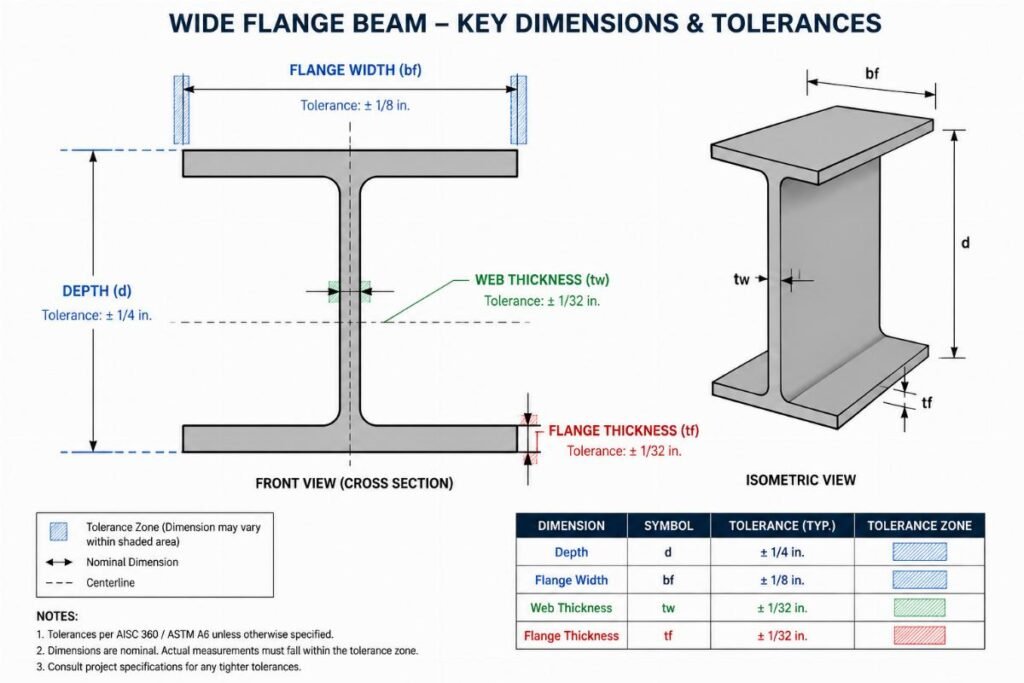
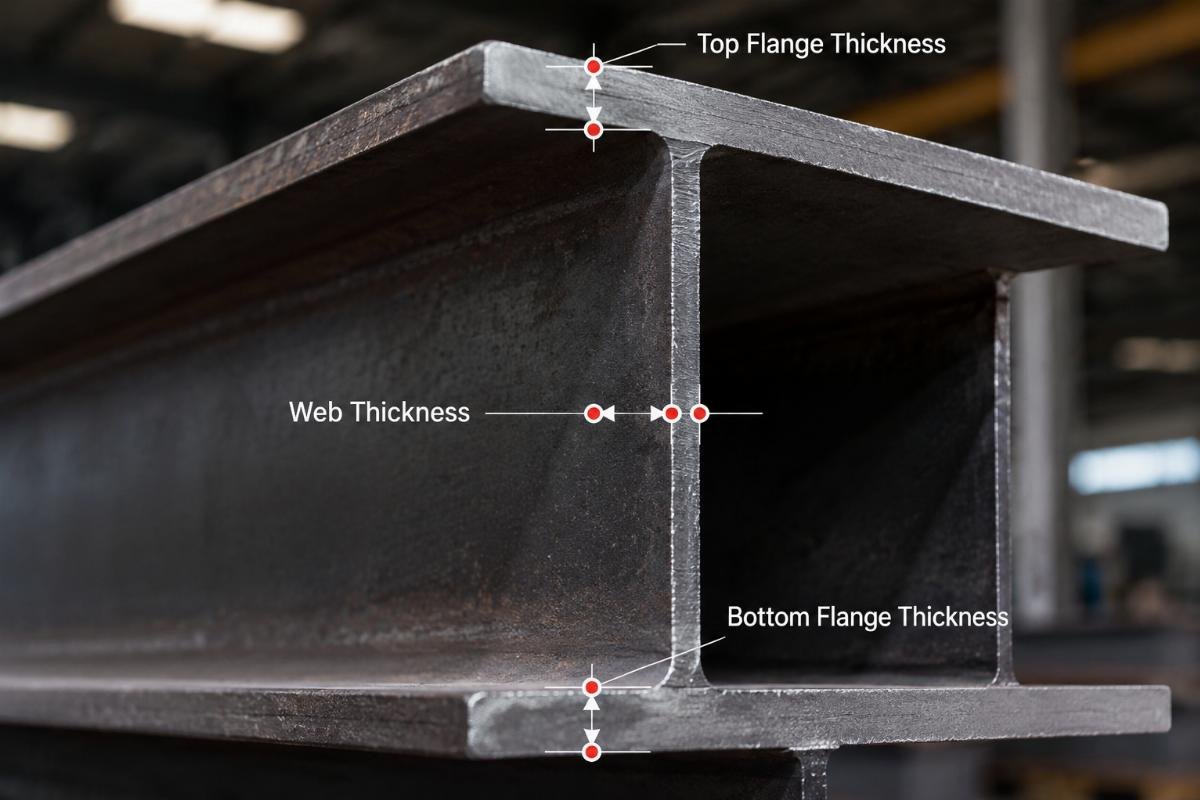
Many buyers request a “W12x26” or similar designation assuming universal consistency. However, the rolling mill origin dictates slight variations in how these dimensions are achieved. The core parameters that require strict definition include Depth (h), Flange Width (b), Web Thickness (tw), and Flange Thickness (tf). Among these, flange thickness is often the most critical for welding connections. If the tolerance on the flange thickness is too loose, fit-up issues arise during assembly, forcing costly on-site grinding or shimming.
Consider the difference between a standard commercial beam and one destined for a high-load seismic zone. The latter requires tighter control over the web thickness to ensure consistent shear capacity. In my experience, specifying only the nominal weight per meter is insufficient because mills can achieve the same weight through different combinations of web and flange dimensions. This variability can impact the moment of inertia and section modulus, which are vital for structural calculations. [NEED_CITE: relationship between dimensional tolerances and structural integrity in AISC manual]
| Parameter | Standard Commercial Tolerance | High-Precision Structural Tolerance | Impact of Deviation |
|---|---|---|---|
| Depth (h) | ±2-3 mm | ±1.5 mm | Affects overall story height and alignment |
| Flange Width (b) | ±3 mm | ±2 mm | Influences connection plate fit-up |
| Web Thickness (tw) | ±0.5 mm | ±0.3 mm | Critical for shear load capacity |
| Flange Thickness (tf) | ±0.8 mm | ±0.5 mm | Determines weld volume and strength |
A contractor in Southeast Asia once faced delays because the beams supplied had flanges that were technically within the broad ASTM limits but too thick for their pre-drilled connection plates. They had to re-drill hundreds of holes on-site. By contrast, when we supply Wide Flange Beam Specifications for precision projects, we align the rolling process to meet the tighter end of the tolerance spectrum, ensuring seamless integration with fabricated components.
How Do Tolerance Standards Affect Your Project?
Strict adherence to EN10210 or ASTM A6 tolerance classes prevents assembly failures and ensures that the steel fits the design model without modification.
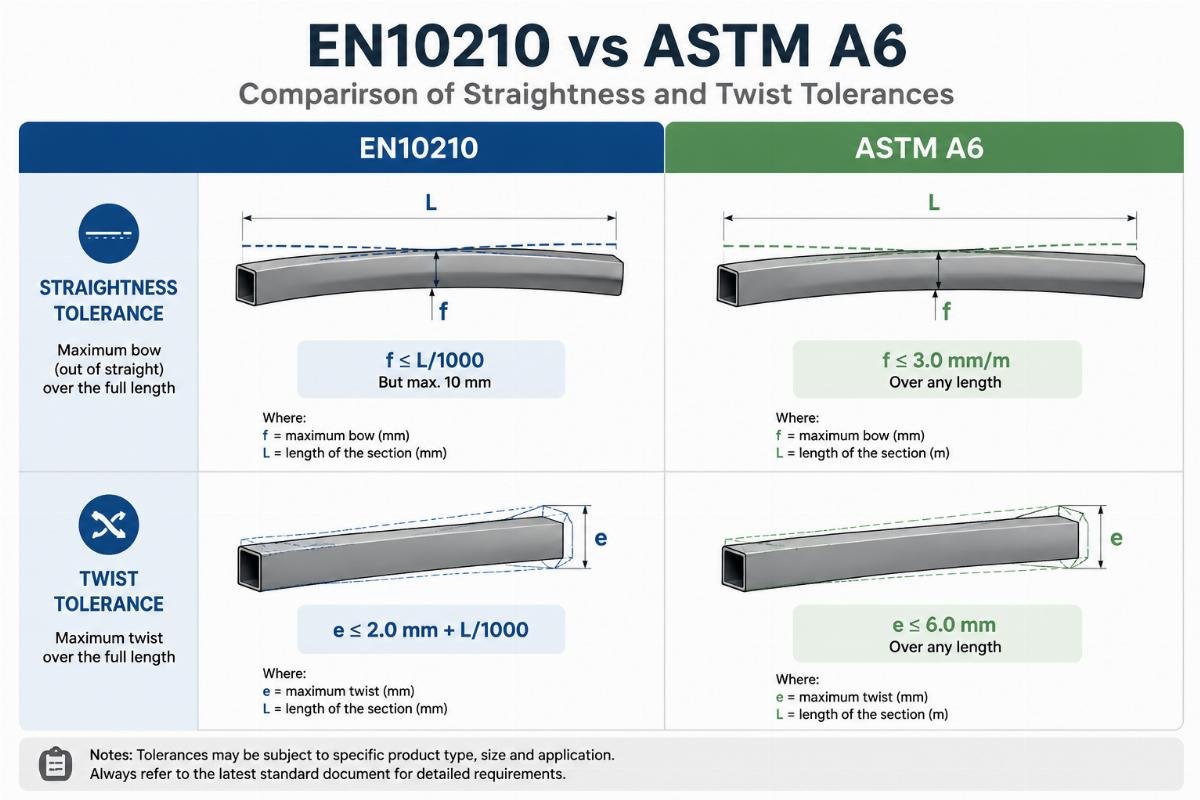
Tolerances are not just about aesthetics; they are about constructability. The European standard EN10210 defines specific classes for hot-finished hollow sections and structural shapes, while ASTM A6 covers general requirements for rolled structural steel bars, plates, shapes, and sheet piling. Confusing these two can lead to significant issues. For instance, EN10210 often demands stricter straightness and twist limits compared to the general provisions of ASTM A6 for certain profiles.
I recall a mixed-standard confusion case where a contractor requested ASTM A992 material but needed it to comply with local European building codes that referenced EN standards. The beam met the chemical composition requirements but failed the geometric tolerance checks required by the local inspector. This is a frequent issue in mixed-container shipments where different standards are applied inconsistently. [NEED_CITE: comparison of EN10210 vs ASTM A6 tolerance requirements]
To avoid this, we classify our production based on the destination’s regulatory framework. For projects in the EU or regions adopting Eurocodes, we enforce EN10210 Class C tolerances. For North American or general international projects, we adhere to ASTM A6. Our in-house laboratory verifies these dimensions before shipment, providing a certificate of conformity that details the actual measured values against the specified standard. This level of transparency eliminates the guesswork for the buyer’s engineering team.
When reviewing Wide Flange Beam Specifications, always check if the tolerance class is explicitly stated. If it is missing, assume the lowest common denominator, which may not suffice for your application. Requesting a sample inspection report before full production can clarify whether the manufacturer understands the specific geometric constraints of your project.
Which Material Grade Matches Your Local Building Code?
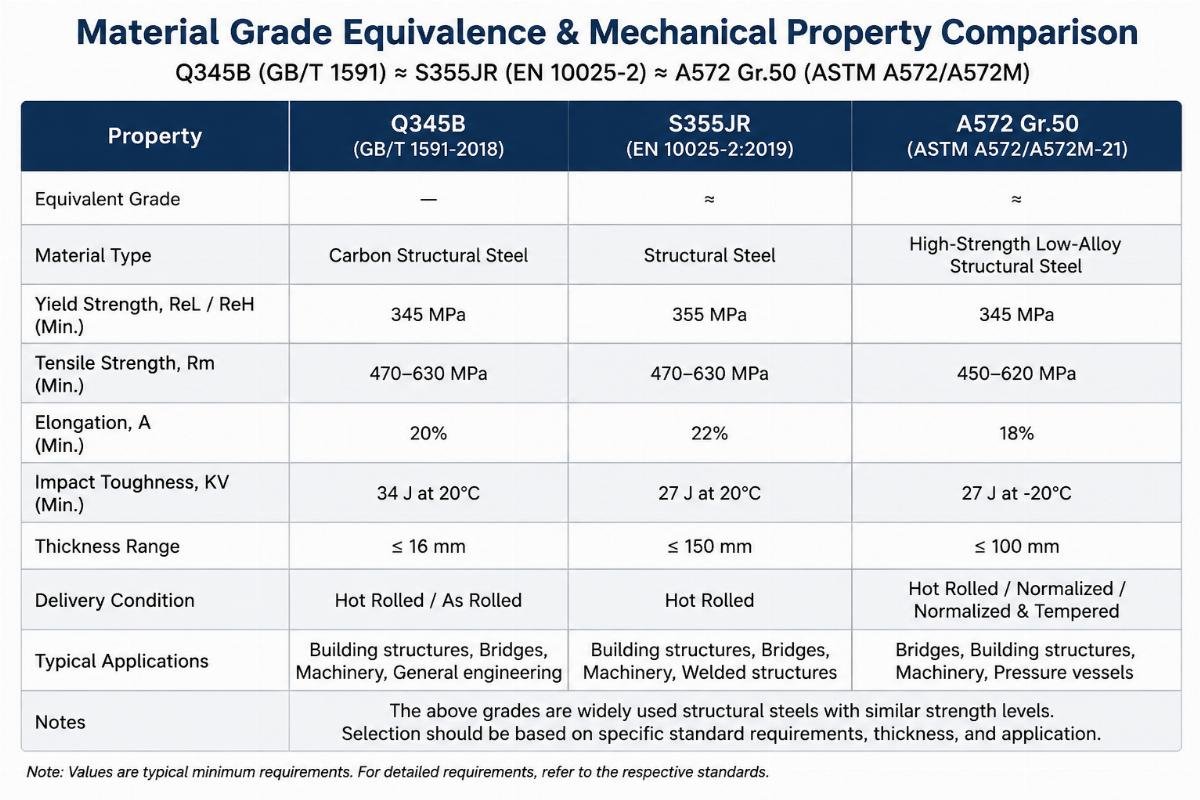
Correctly mapping material grades such as Q345B to S355JR or A572 Gr.50 ensures regulatory compliance and avoids costly re-testing at the destination port.
Material equivalence is a complex area where many procurement errors occur. While Q345B (Chinese standard) and S355JR (European standard) share similar yield strengths, their chemical compositions and impact testing requirements differ. S355JR requires specific Charpy V-notch impact energy values at room temperature, which may not be automatically guaranteed in all Q345B batches unless specifically requested. Similarly, ASTM A572 Gr.50 is often used as an equivalent, but its carbon equivalent value (CEV) might differ, affecting weldability in thick sections.
A distributor in the Middle East once received a shipment labeled as “equivalent to S355” but lacking the specific CE marking and EN10210 certification. The local authorities rejected the material for a public infrastructure project because the mill test certificate did not reference the harmonized European standard. The cost of re-certification and potential replacement far exceeded the initial savings. [NEED_CITE: guidelines for cross-standard material substitution in international construction]
We address this by providing full traceability. Our production lines are certified to produce S355J0/JR/J2 grades under EN10210/EN10219 standards. When a buyer requests Wide Flange Beam Specifications, we confirm the exact grade required by their local code and provide the corresponding Mill Test Certificate (MTC) that lists the actual chemical analysis and mechanical properties. This includes yield strength, tensile strength, elongation, and impact energy values.
For buyers navigating multiple standards, we offer a clear equivalence table in our technical documentation. However, we always advise verifying with the local structural engineer, as some jurisdictions have specific restrictions on imported grades. Our ability to produce custom non-standard sizes also allows us to adjust the chemistry slightly to meet specific CEV requirements for challenging welding environments, ensuring that the material not only meets the strength criteria but also the fabrication needs.
Why Surface Treatment Matters for Exported Beams?
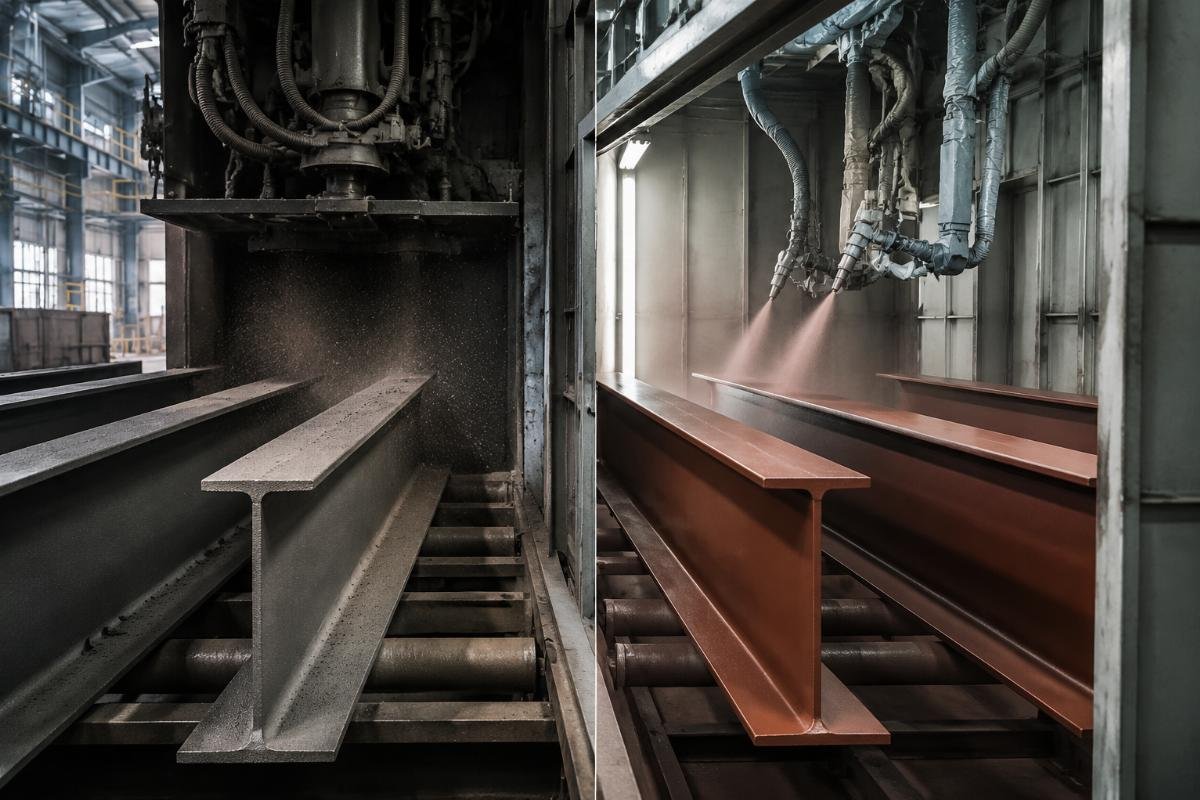
Proper shot blasting and painting extend the lifespan of structural steel in corrosive environments, preventing premature rust and maintaining structural integrity.
Surface treatment is often treated as an afterthought, yet it is the first line of defense against environmental degradation. Beams arriving with inadequate rust protection in humid climates like Southeast Asia or coastal regions in the Middle East can begin to corrode within weeks. This not only affects the aesthetic appeal but can also compromise the bond between the steel and fireproofing materials or concrete encasements.
I have seen shipments where standard black oxide finish was applied, only for the beams to develop heavy surface rust during sea transit due to condensation inside the container. The buyer had to invest in extensive on-site cleaning and repainting, delaying the project schedule. In contrast, hot-dip galvanizing or high-quality epoxy painting provides robust protection. [NEED_CITE: corrosion rates of untreated vs protected structural steel in marine environments]
Our process includes optional shot blasting to Sa 2.5 standard, which removes mill scale and rust, creating a clean profile for paint adhesion. We then apply primer and topcoat systems tailored to the expected service life and environment. For extreme conditions, we recommend hot-dip galvanizing, which offers superior longevity. When specifying Wide Flange Beam Specifications, include the surface preparation standard (e.g., ISO 8501-1) and the paint system details (dry film thickness, type of primer).
This attention to detail ensures that the beams arrive ready for installation, reducing on-site labor and improving the overall quality of the finished structure. It is a small investment that yields significant returns in terms of durability and maintenance savings.
Conclusion
Accurate specification prevents costly delays.
Procuring structural steel requires a holistic view that integrates dimensional tolerances, material certifications, and surface protection. By defining these elements clearly in your Wide Flange Beam Specifications, you ensure compliance with local codes and smooth project execution. Partnering with a manufacturer who understands these technical nuances and provides verified documentation turns a potential risk into a reliable foundation for your construction projects.
Tags
Share this article

Written by
author
Editor covering global sourcing, supplier verification, and industrial product knowledge. Content is compiled from manufacturer specifications, industry standards, and hands-on experience with international B2B buyers. Every article is fact-checked before publishing to help procurement professionals make informed decisions.
View all posts →Keep Reading
Related Articles
August 15, 2026
Narrow Flange Beam for Sale | EN-Standard Wholesale Supplier
Source EN-certified Narrow Flange Beam with strict dimensional tolerances to prevent port rejection. Verify S355JR yield strength and third-party Mill...
Read article →Discussion