
Chinese vs European Steel Beam Cost: EN S355 Wholesale Supplier
Chinese vs European Steel Beam Cost: EN S355 Wholesale Supplier
The cheapest FOB price often results in the most expensive final project cost.
Chinese steel beams offer a lower initial unit price compared to European mills, but the total landed cost depends entirely on strict adherence to EN-standard certification and impact test compliance. Failing to specify the correct grade suffix can lead to cargo rejection that erases all initial savings.
Walking through the warehouse in Jinan, the difference between a standard Q345B beam and an EN-certified S355J2 beam is not visible to the naked eye. Both look like heavy, grey H-sections stacked in neat rows. However, the paperwork attached to each bundle tells a completely different story of risk and liability. I have seen containers sit idle at European ports for weeks because the Mill Test Certificate did not explicitly state the impact energy values at minus twenty degrees Celsius. The steel itself was structurally sound, but the documentation failed to prove it met the specific cold-weather requirements of the project. This disconnect between physical quality and certified compliance is where most buyers lose money. [NEED_CITE: common causes of steel import rejection in EU ports]

Understanding this distinction requires looking beyond the base price per ton. It demands a rigorous analysis of how standards translate across borders and how logistics interact with quality verification.
Is Chinese Steel Beam Really Cheaper Than European?
Lower FOB prices do not automatically mean lower total project costs.
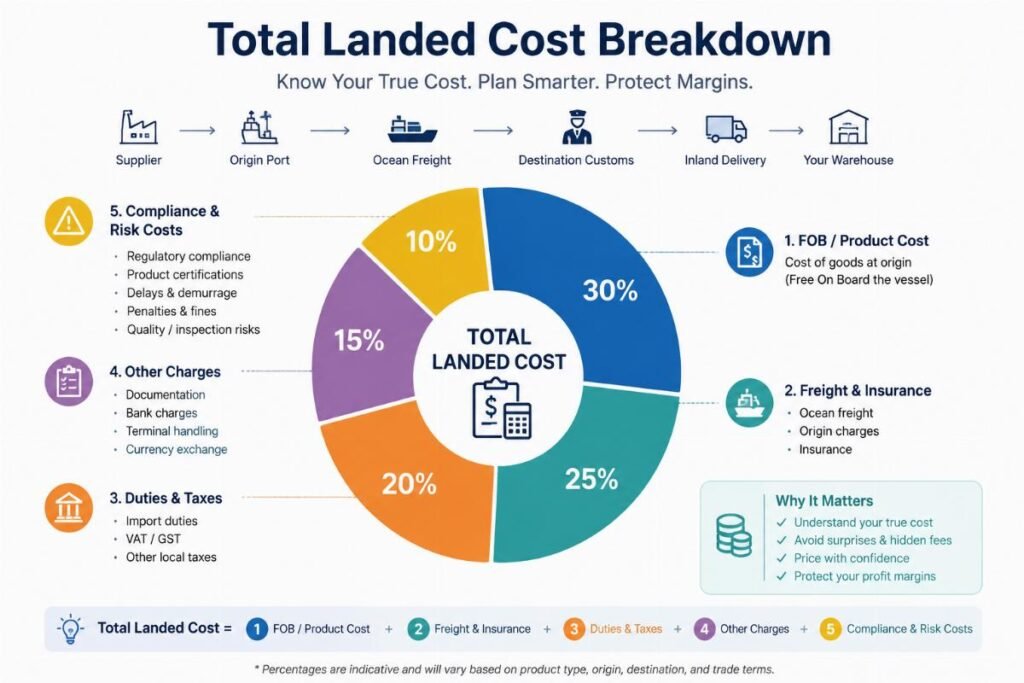
When comparing a Chinese Steel Beam vs European Steel Beam, the initial quote from a Chinese supplier is typically significantly lower. This gap exists due to differences in raw material sourcing, labor costs, and domestic market dynamics. However, the final cost includes ocean freight, insurance, port handling charges, customs duties, and internal logistics. For many projects, the FOB price represents only a portion of the total expenditure.
The hidden variable is the cost of compliance. European manufacturers produce steel under EN10025 standards by default, meaning their documentation is inherently aligned with local building codes. Chinese manufacturers produce primarily for the domestic GB/T market. To export to Europe, they must actively switch production lines to meet EN standards, which involves additional testing, third-party inspection fees, and stricter quality control protocols. If a buyer selects a supplier who does not have established EN certification processes, the risk of non-compliance increases.
Consider the logistics of a mixed-container shipment. Consolidating H-beams with hollow sections can reduce per-unit logistics costs noticeably compared to less-than-container-load shipments. This efficiency is only possible when the supplier has the capacity to handle diverse product lines under a single quality management system. A supplier focused solely on volume may not offer the flexibility required for such consolidation, forcing buyers into more expensive shipping arrangements. [NEED_CITE: logistics cost optimization strategies for structural steel imports]

The key is to calculate the total landed cost, not just the ex-works price. A slightly higher FOB price from a certified supplier who provides accurate documentation and efficient packing can result in a lower final cost by avoiding delays, re-inspections, and potential rejection.
Critical Differences in Standards: EN10025 vs GB/T
Grade equivalence is not a simple one-to-one mapping.
Many buyers assume that Q345B is the direct equivalent of S355JR. While they share similar yield strength requirements, the chemical composition limits and impact testing requirements differ. The European standard EN10025 is highly specific about the suffix letters, which denote the impact temperature. JR indicates room temperature impact testing, J0 indicates zero degrees Celsius, and J2 indicates minus twenty degrees Celsius. The Chinese GB/T standard does not use this same suffix system in the same way, leading to frequent specification errors.
| Feature | EN10025 S355 Series | GB/T Q345 Series | Equivalence Note |
|---|---|---|---|
| Yield Strength | 355 MPa (min) | 345 MPa (min) | Close mechanical match |
| Impact Temp Suffix | JR / J0 / J2 / K2 | No direct suffix equivalent | Must specify temp explicitly |
| Certification Type | EN10204 3.1 or 3.2 | GB/T Factory Certificate | EN requires specific format |
| CE Marking | Mandatory for EU | Not applicable | Critical for EU construction |
A common mistake is ordering Q345B when the project specifies S355J2. The Q345B material may meet the strength requirement, but if it was not tested at minus twenty degrees, it cannot be certified as J2. Using it in a cold climate structure creates a liability risk. [NEED_CITE: technical comparison of EN10025 and GB/T structural steel standards]
For a Middle East warehouse developer using S235JR, the equivalence with Q235B is more straightforward, as impact testing at room temperature is less critical in warm climates. However, even in these cases, the certification format must meet local authority requirements. Some jurisdictions accept mill certificates from recognized Chinese mills, while others require third-party verification. Understanding these local nuances is essential for smooth project execution.
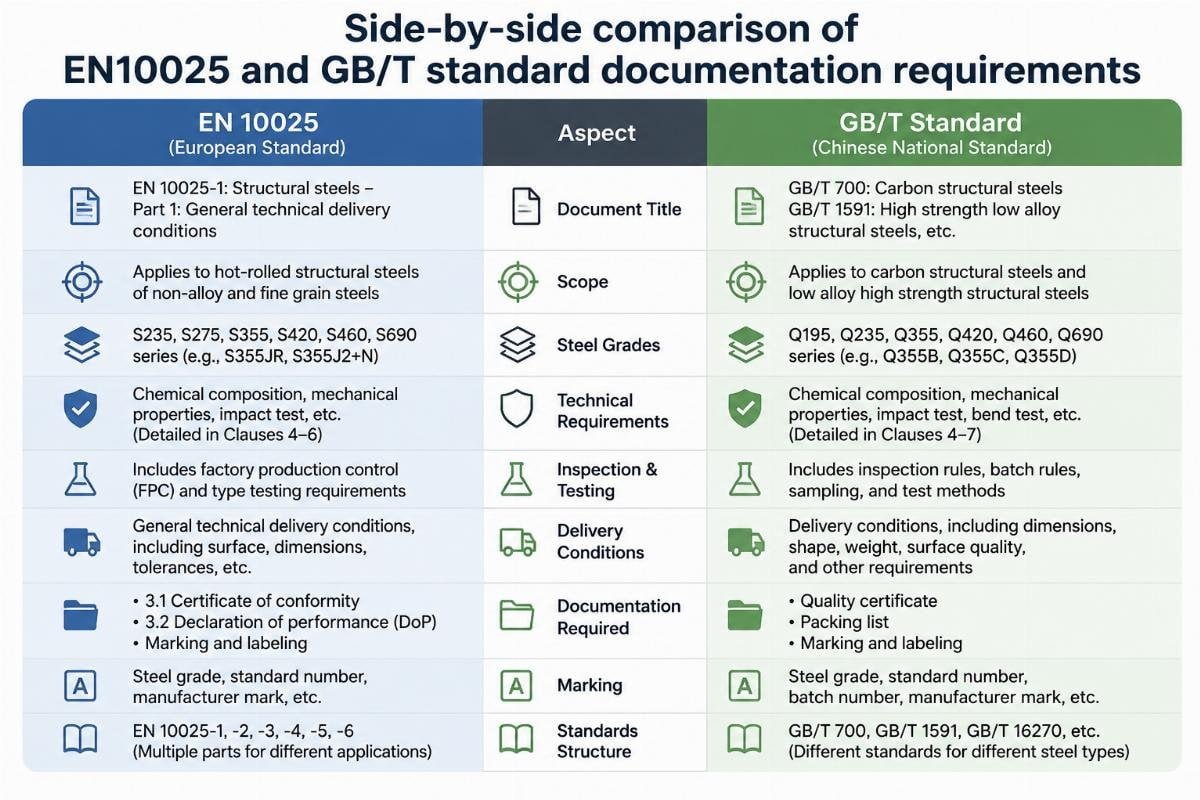
Buyers must provide suppliers with the exact EN grade, including the suffix, and confirm that the mill can produce material that meets those specific impact energy values. Relying on general equivalence tables without verifying the specific batch properties is a significant risk.
The Hidden Cost of Non-Compliance: Impact Testing Risks
Ignoring the impact temperature suffix can lead to total cargo rejection.
The most costly error in steel importing is failing to specify the correct impact temperature. A Polish infrastructure project requiring S355J2 beams once faced this issue. The supplier delivered beams that met the strength requirements but had only been tested at room temperature. When the independent inspector arrived at the port, he requested the impact test results for minus twenty degrees Celsius. The certificate did not contain this data.
The entire container was rejected. The cost of air-freighting replacement beams from China to Poland was several times the original sea freight cost. Additionally, the project faced delays, penalty clauses from the main contractor, and storage fees for the rejected goods. This scenario illustrates how a small oversight in specification can lead to a mid-six-figure loss. [NEED_CITE: case studies of steel import failures due to certification errors]
In contrast, a supplier with an in-house laboratory and established EN certification processes can prevent this. By conducting impact tests on every batch according to EN10025 requirements, they ensure that the Mill Test Certificate accurately reflects the material properties. This proactive approach eliminates the risk of rejection at the destination port.

Buyers should always request sample impact test reports before placing a large order. Verify that the testing temperature matches the project specification. If the supplier cannot provide this data, they are not capable of supplying EN-certified steel, regardless of their claims.
How to Verify Quality Before Shipment?
Third-party inspection and detailed MTC review are non-negotiable.
Verifying the quality of structural steel requires more than a visual inspection. The Mill Test Certificate (MTC) is the primary document that proves compliance. It must be issued according to EN10204 type 3.1 or 3.2, depending on the project requirements. Type 3.1 is issued by the manufacturer, while type 3.2 involves an independent inspector. For critical projects, type 3.2 is often mandatory.
The MTC must include specific data points: chemical composition, mechanical properties, and impact energy values at the specified temperature. Buyers should check that the heat number on the certificate matches the markings on the steel beams. Any discrepancy indicates a potential mix-up or fraud. [NEED_CITE: guidelines for verifying Mill Test Certificates for structural steel]
A robust verification process includes:
- Reviewing the MTC: Ensure all required data points are present and within limits.
- Checking CE Marking: Verify that the CE mark is applied correctly and corresponds to the declared performance.
- Third-Party Inspection: Hire an independent inspector to witness loading and verify dimensions and markings.
- Laboratory Testing: For high-risk projects, conduct independent laboratory tests on samples taken from the batch.
Suppliers with in-house laboratories, such as those adhering to EN10219 and EN10210 standards, can provide faster turnaround times for test results. This capability allows for quicker resolution of any queries before shipment. It also demonstrates a commitment to quality control that goes beyond basic production.

Do not rely solely on the supplier’s word. Insist on seeing the actual test records and, if possible, visit the factory to observe the testing process. This level of diligence protects your investment and ensures project continuity.
Making the Right Choice for Your Project
Certified Chinese steel offers best value for standard structures when compliance is verified.
For standard construction projects, such as warehouses and industrial buildings, certified Chinese steel provides an excellent balance of cost and quality. The key is to work with a supplier who understands the EN standards and has a proven track record of successful exports to Europe. These suppliers have already navigated the complexities of certification and logistics, reducing the risk for the buyer.
For critical high-spec projects, such as bridges or high-rise buildings in cold climates, the verification process must be even more rigorous. In these cases, the cost of failure is too high to take any shortcuts. Engaging a third-party inspection agency and requiring type 3.2 certificates is essential. The slight increase in upfront cost is negligible compared to the potential losses from non-compliance.

Ultimately, the choice between Chinese and European steel depends on the project’s specific requirements and the buyer’s risk tolerance. By focusing on total landed cost and strict compliance verification, buyers can confidently source high-quality steel from China without compromising on safety or performance. The goal is not just to buy steel, but to buy certainty.
Conclusion
True cost savings come from compliance accuracy, not just low unit prices.
Selecting the right Chinese Steel Beam vs European Steel Beam requires a holistic view of cost, risk, and compliance. By understanding the nuances of EN standards, verifying impact test data, and working with certified suppliers, buyers can secure high-quality materials at competitive prices. The initial effort in verification pays dividends in project stability and financial predictability.
Share this article

Written by
author
Editor covering global sourcing, supplier verification, and industrial product knowledge. Content is compiled from manufacturer specifications, industry standards, and hands-on experience with international B2B buyers. Every article is fact-checked before publishing to help procurement professionals make informed decisions.
View all posts →Keep Reading
Related Articles
August 13, 2026
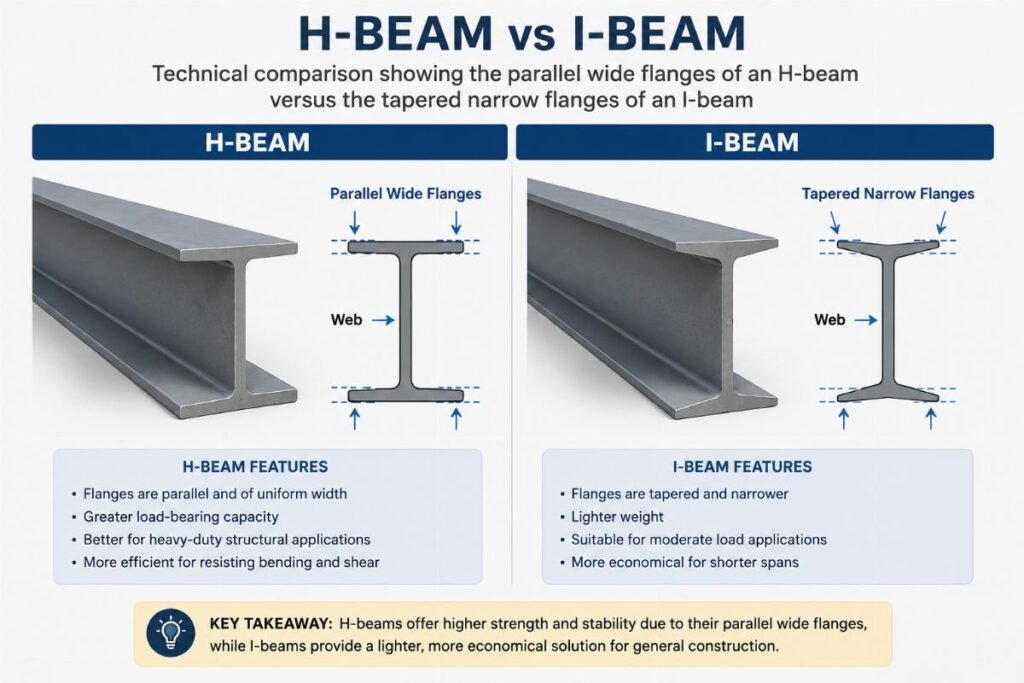
H-Beam vs I-Beam: EN-Certified Manufacturer for Construction Wholesale
H-beams and I-beams are not interchangeable structural components, making precise H-beam vs I-beam selection critical for project safety. Wide parallel...
Read article →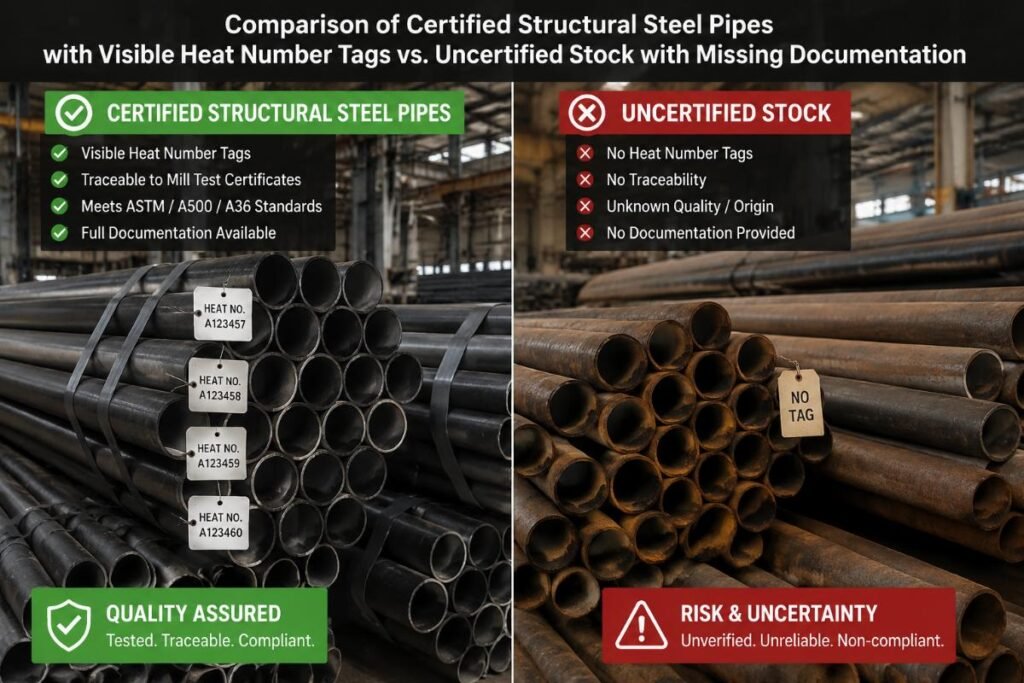
August 13, 2026
EN10219 S355JR Steel Fabricator vs Regional Distributor Wholesale
Navigate the EN10219 S355JR Steel Fabricator vs Distributor decision to avoid costly site rejections from non-compliant stock. Discover how direct...
Read article →Discussion