
EN Standard Structural Steel Beam Mill Certificate Wholesale Supplier
EN Standard Structural Steel Beam Mill Certificate Wholesale Supplier
A mill certificate is not a formality; it is the legal proof of structural integrity.
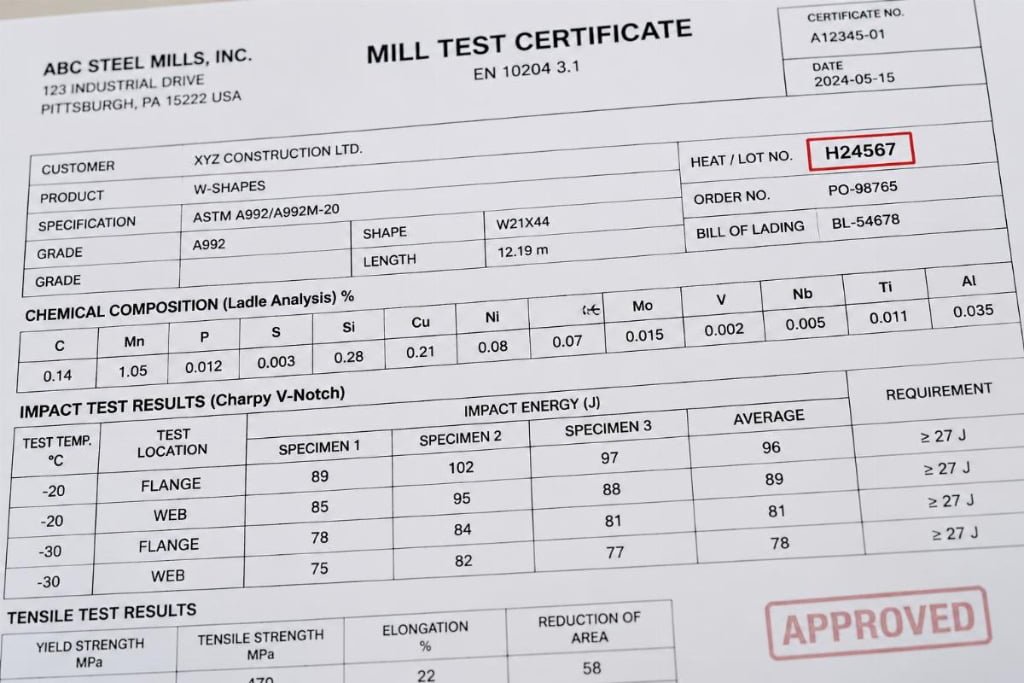
For buyers sourcing structural steel beams, a valid Mill Test Certificate (MTC) must strictly comply with EN 10204 Type 3.1 standards, explicitly listing heat numbers, chemical composition, and mechanical properties including impact energy at specified temperatures. Without these verified data points aligned with EN10210 or EN10219 requirements, customs clearance in the EU and site acceptance in major infrastructure projects are impossible. This guide details the critical verification steps to ensure your Mill Certificate Standards for Structural Steel Beam Export documentation prevents costly delays and rejections.
I still remember the silence on the phone line when a procurement manager in Dubai told me his entire shipment of H-beams was sitting at Jebel Ali port. The issue was not the steel quality itself, but a single line on the paperwork. The mill certificate listed the impact test temperature as +20°C, while the project specification for S355J2 grade required -20°C. The consultant engineer rejected the batch outright. The storage fees accumulated daily, eventually exceeding the profit margin of the entire contract. That incident shifted my perspective from simply moving goods to understanding that in structural steel, the paper trail is as critical as the metal. When dealing with Mill Certificate Standards for Structural Steel Beam Export, every decimal point and degree Celsius matters.
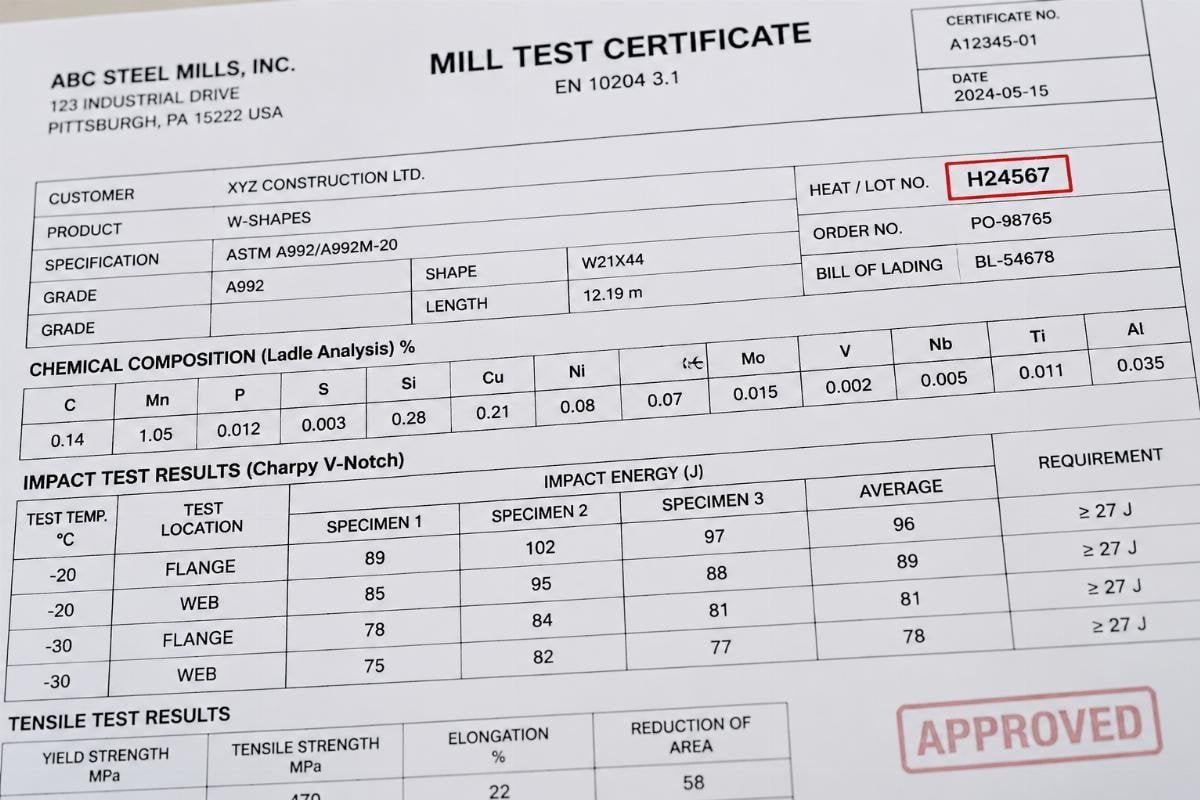
Understanding these nuances separates a reliable partner from a risky supplier. Let us break down exactly what makes a certificate valid and how to verify it before the vessel leaves the port.
What Are the Mandatory Elements of a Structural Steel Mill Certificate?
A compliant MTC must trace every beam back to its specific melt and heat treatment process.
The core function of a mill certificate is traceability. It links the physical product to the production data. For structural beams intended for export, particularly under European norms, the document must adhere to EN 10204 standards. The most common requirement for major construction projects is Type 3.1, which involves independent inspection by a representative of the purchaser or an authorized third party, distinct from the manufacturer’s own quality department [NEED_CITE: EN 10204 certificate types and inspection requirements].
Key fields that must appear on every page include:
- Heat Number: This unique identifier connects the certificate to the actual markings on the steel bundles. If the heat number on the paper does not match the stencil on the beam, the certificate is void for that batch.
- Chemical Composition: Detailed percentages of carbon, manganese, silicon, sulfur, and phosphorus. These elements determine weldability and strength.
- Mechanical Properties: Yield strength, tensile strength, and elongation. These values prove the steel can handle the designed loads.
- Impact Energy: Measured in Joules at a specific temperature. This is crucial for structures in cold climates or dynamic load environments.
Many buyers mistakenly accept Type 2.2 certificates, which are merely a manufacturer’s declaration without independent verification. While acceptable for non-critical applications, Type 2.2 lacks the third-party oversight required for high-risk structural frameworks. When evaluating Mill Certificate Standards for Structural Steel Beam Export, insisting on Type 3.1 ensures that an independent eye has verified the test results against the standard.
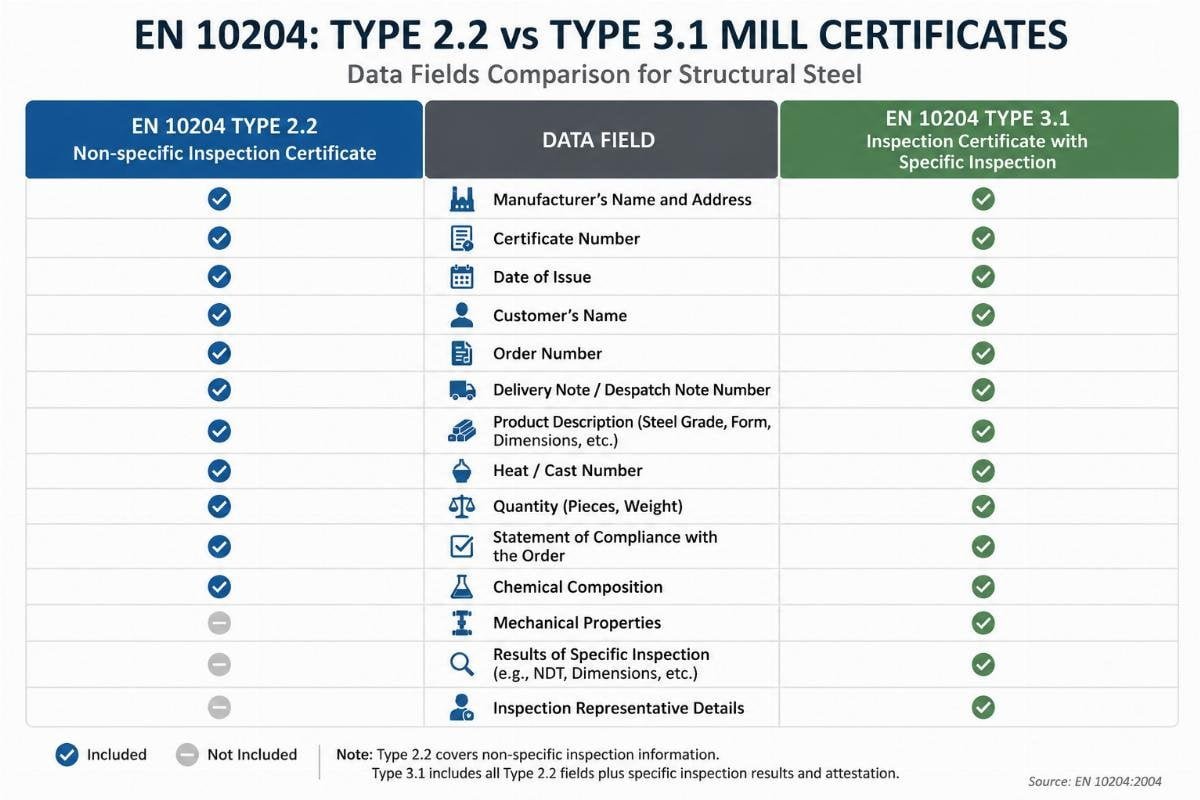
The difference lies in accountability. A Type 3.1 certificate carries legal weight because it confirms that the testing equipment was calibrated and the procedures followed were audited. Without this layer of verification, you are relying solely on the producer’s internal word, which offers little recourse if failures occur on site.
Why Do EN10210/EN10219 Certificates Fail Customs or Site Inspection?
Most rejections stem from mismatched impact test temperatures and missing CE marking references.
Even when a certificate looks complete, subtle discrepancies can trigger immediate rejection. The most frequent error involves the impact test temperature for normalized or thermo-mechanically rolled steels. For instance, S355J2 steel requires impact energy testing at -20°C. If the certificate lists tests conducted at +20°C or 0°C, the material does not meet the J2 designation, regardless of how high the Joule values are. This mismatch is a common cause of batch rejection in Middle Eastern and Northern European projects where low-temperature toughness is mandatory [NEED_CITE: EN 10025 structural steel impact test temperature requirements].
Another critical failure point is the absence of proper CE marking documentation. For exports to the EU, the Declaration of Performance (DoP) must reference the correct harmonized standard, such as EN 10210 for hot-finished hollow sections or EN 10219 for cold-formed sections. Customs officials often check for this specific reference. If the MTC cites an outdated standard or omits the CE mark entirely, the shipment can be held for weeks while the supplier attempts to rectify the documentation.
Consider a case where a European contractor received a container of rectangular hollow sections. The steel quality was perfect, but the MTC referenced EN 10025 instead of EN 10219. Although the chemical and mechanical properties were identical, the wrong standard citation meant the product could not be legally placed on the market under the Construction Products Regulation. The resulting delay incurred significant demurrage charges. To avoid this, always cross-check the standard cited on the Mill Certificate Standards for Structural Steel Beam Export documents against the purchase order specifications.
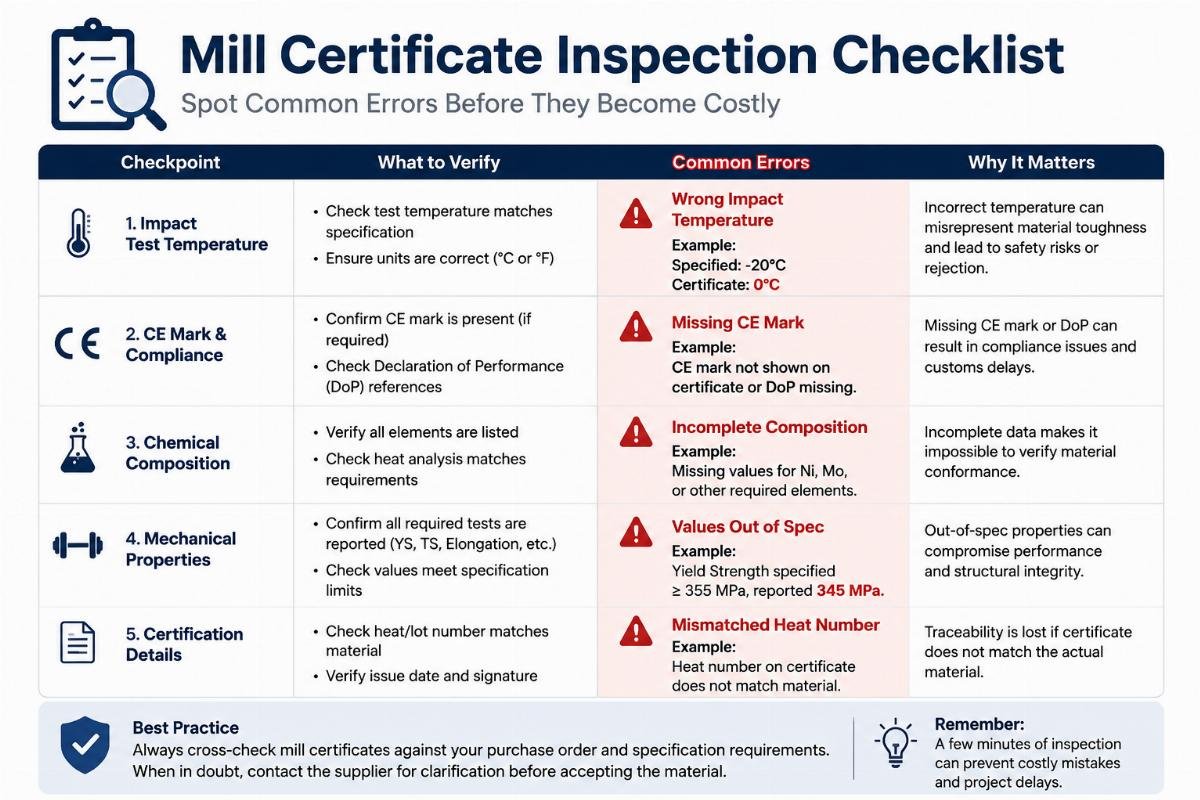
These errors are not just administrative; they reflect a lack of rigorous quality control in the documentation process. A supplier who cannot get the paper right often struggles with consistency in production. Verifying these details before shipment is far cheaper than arguing with customs agents after arrival.
How to Verify the Authenticity of a Mill Test Certificate?
Cross-referencing physical markings with digital records is the only way to ensure validity.
Forged or altered certificates are a rare but serious risk in international trade. Verification requires a multi-step approach that goes beyond reading the PDF. First, request the original signed and stamped copy. Digital copies can be easily edited, but original documents with wet ink signatures and embossed stamps are harder to falsify. Second, match the heat numbers on the certificate with the physical markings on the steel bundles. Each bundle should have the heat number stenciled or tagged clearly. If the tags are missing or illegible, the certificate cannot be trusted for those items.
Third, contact the mill directly if possible. Many reputable manufacturers have online verification portals where you can enter the heat number to confirm the test results match their internal database. This step provides an additional layer of security, ensuring that the document you hold was indeed issued by the producer. In cases where direct verification is not available, requesting a third-party inspection report from agencies like SGS or Bureau Veritas can serve as a proxy for authenticity.
A buyer once shared how they avoided a potential fraud by noticing that the font used for the yield strength values differed slightly from the rest of the document. Upon investigation, it turned out the supplier had attempted to alter the values to meet a tighter specification. By insisting on strict Mill Certificate Standards for Structural Steel Beam Export verification protocols, including physical cross-checks, such discrepancies can be caught before payment is released.
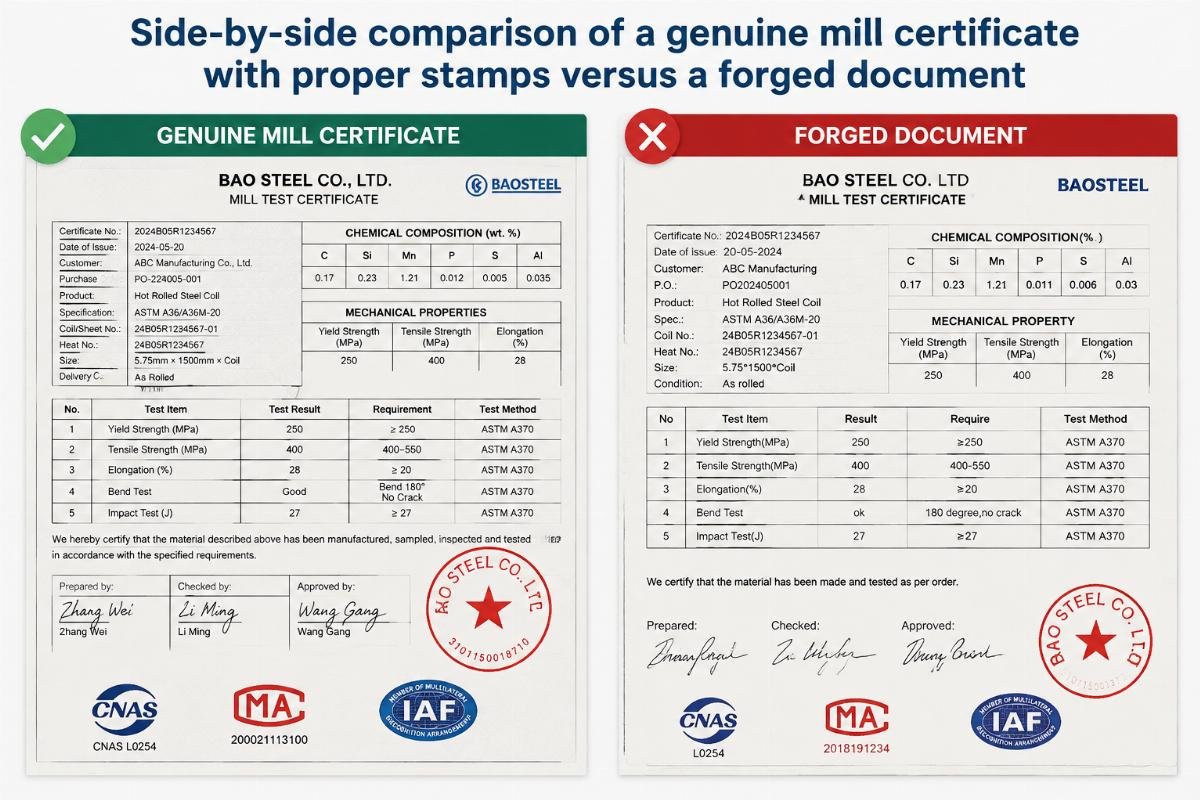
Authenticity checks protect your investment and your reputation. A failed structure due to substandard material traced back to your procurement can have lasting legal consequences. Therefore, treating certificate verification as a critical quality control step is essential.
What Is the Difference Between Type 2.2 and Type 3.1 Certificates?
Type 3.1 includes independent verification, making it mandatory for high-risk structural applications.
The distinction between EN 10204 Type 2.2 and Type 3.1 is fundamental to procurement strategy. Type 2.2 is a certificate of compliance where the manufacturer declares that the products meet the order requirements based on their own internal testing. It does not involve any external witness or independent inspector. This type is suitable for general commercial steel where failure consequences are low, such as non-structural supports or temporary works.
In contrast, Type 3.1 requires that the testing and inspection be witnessed by an authorized representative of the purchaser or an independent third-party inspector. This witness verifies that the tests were performed correctly and that the results are accurate. The certificate is then signed by both the manufacturer’s quality authority and the independent inspector. This dual-signature requirement provides a higher level of assurance and is typically mandated for pressure vessels, bridges, and high-rise buildings [NEED_CITE: difference between EN 10204 Type 2.2 and 3.1 certificates].
| Feature | Type 2.2 Certificate | Type 3.1 Certificate |
|---|---|---|
| Verification Level | Manufacturer’s self-declaration | Independent witness verification |
| Signatories | Manufacturer’s quality manager | Manufacturer + Independent Inspector |
| Typical Use Case | Non-critical structural, general fabrication | High-risk structures, pressure equipment, bridges |
| Risk Profile | Higher reliance on supplier integrity | Lower risk due to third-party oversight |
| Cost Implication | No additional inspection cost | Includes cost of independent inspection |
Choosing the wrong type can lead to project delays if the client’s engineer rejects the documentation. For most export projects involving structural beams, specifying Type 3.1 in the purchase order is the safest approach. It ensures that the Mill Certificate Standards for Structural Steel Beam Export meet the stringent requirements of international engineering firms.
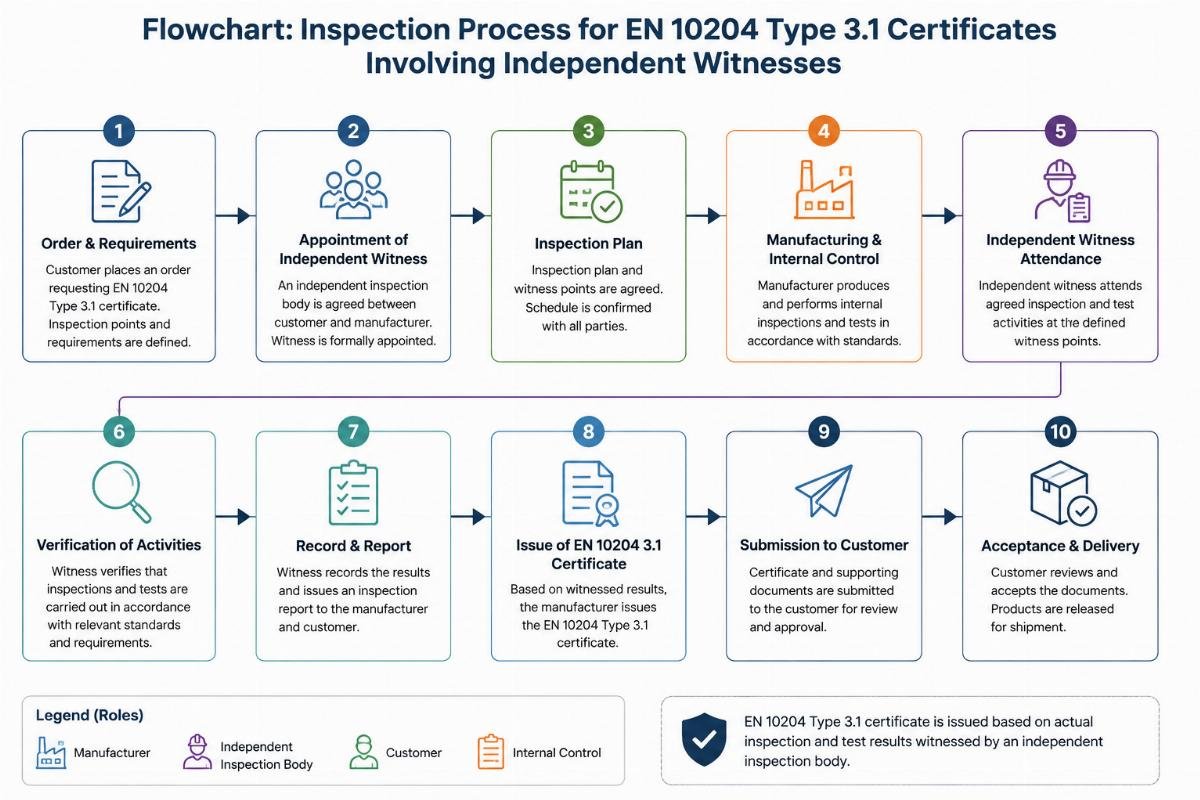
Understanding this difference allows buyers to align their documentation requirements with the risk profile of their project. It also helps in negotiating costs, as Type 3.1 certificates may involve additional fees for third-party inspection services.
Conclusion
Valid documentation is the backbone of successful structural steel procurement.
Ensuring that your mill certificates comply with EN 10204 Type 3.1 standards, accurately reflect impact test temperatures, and match physical heat numbers is non-negotiable for avoiding customs holds and site rejections. By rigorously verifying these details, buyers can secure their supply chain and maintain project timelines. Adhering to strict Mill Certificate Standards for Structural Steel Beam Export protocols transforms paperwork from a bureaucratic hurdle into a powerful tool for quality assurance.
Tags
Share this article

Written by
author
Editor covering global sourcing, supplier verification, and industrial product knowledge. Content is compiled from manufacturer specifications, industry standards, and hands-on experience with international B2B buyers. Every article is fact-checked before publishing to help procurement professionals make informed decisions.
View all posts →Keep Reading
Related Articles
August 12, 2026
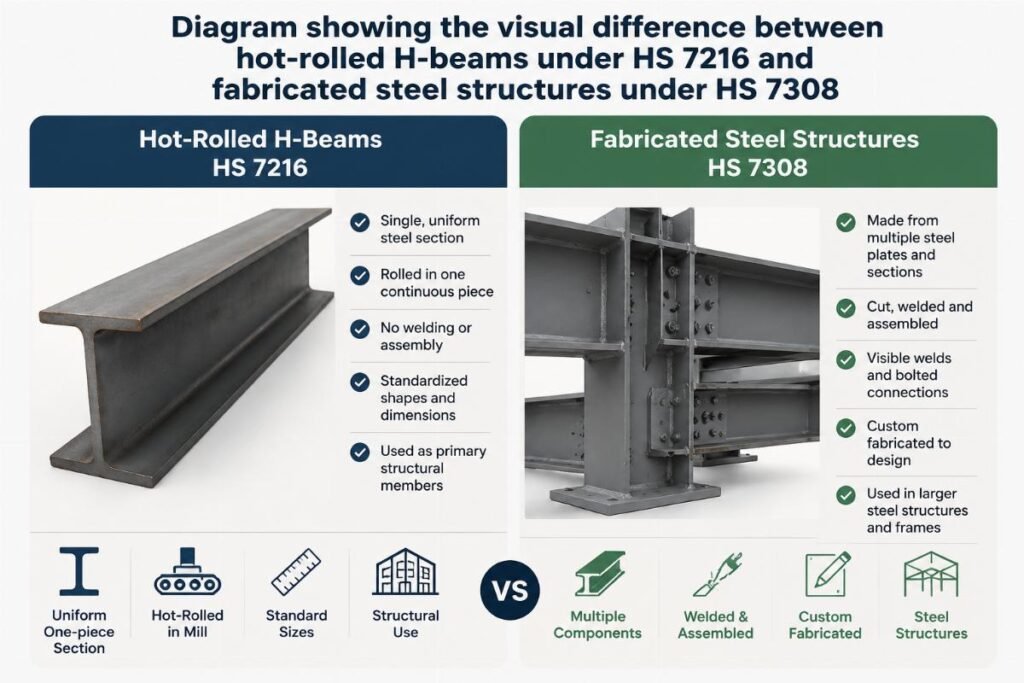
S355JR Steel Beam HS Code for MENA Import Buyers Wholesale
Avoid costly customs delays with the correct Steel Beam HS Code for MENA imports. Distinguish between hot-rolled profiles under heading...
Read article →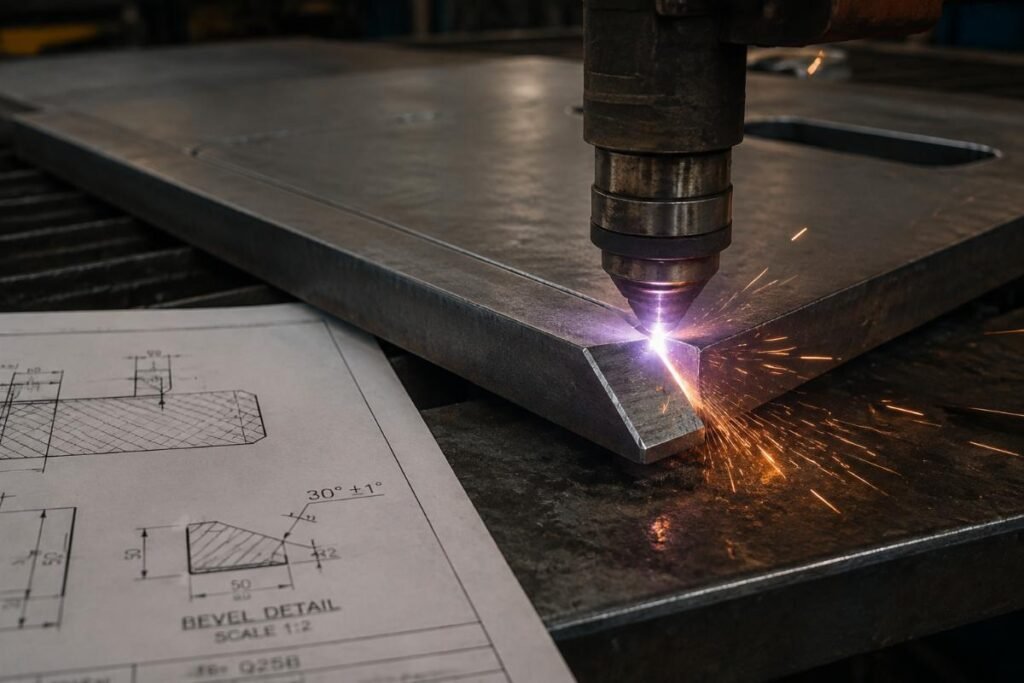
August 11, 2026
Custom Steel Structural Components Cutting & Low MOQ Manufacturer
Navigate the complexities of Steel Structural Components Custom Cutting MOQ by prioritizing container utilization over unit price. Learn how mixed-container...
Read article →
August 11, 2026
EN S355JR Steel Beam Container Loading Config for FCL Buyers
A professional steel beam container loading plan prioritizes structural stability over raw volume to prevent transit deformation. Learn optimal 40ft...
Read article →Discussion